No one pays to be recommended here, and we say when a free or cheaper option wins. Our promise →
In this guide6 sections
Australia’s seasons run opposite to the northern hemisphere’s, and that’s only the first flip worth knowing. The second is bigger: the south and the tropical north keep entirely different calendars, so “is it a good time to visit Australia?” is really two questions wearing one hat. Here’s the honest map.
The south: Sydney, Melbourne, Tasmania

For the southern cities, the shoulder seasons are the quiet winners: September to November (their spring) and March to May (their autumn) bring mild days in the low-to-mid 20s, softer prices, and beaches and harbour walks without the December-January squeeze. The southern summer (December to February) is the classic postcard and the peak crowd; winter (June to August) turns Melbourne moody and Tasmania properly cold — atmospheric if that’s your taste, and cheap.
Once you have dates: where to stay in Sydney and in Melbourne, area by area, and Sydney on New Year's Eve, with the minimum stays to watch for.
The tropical north: Darwin, Kakadu, the Kimberley, Cairns
The north doesn’t do four seasons; it does two. The dry season (May to October) is the travel window — clear skies, lower humidity, waterfalls still full from the wet, and the Great Barrier Reef at its best underwater visibility. The wet season (roughly November to April) brings monsoonal storms, road closures — and marine stingers along the northern coasts that keep swimmers inside netted enclosures or in stinger suits. The wet has its own drama (Kakadu’s waterfalls at full roar), but it’s a trip for the prepared, not for a first visit with fixed plans.
The center: Uluru and the outback
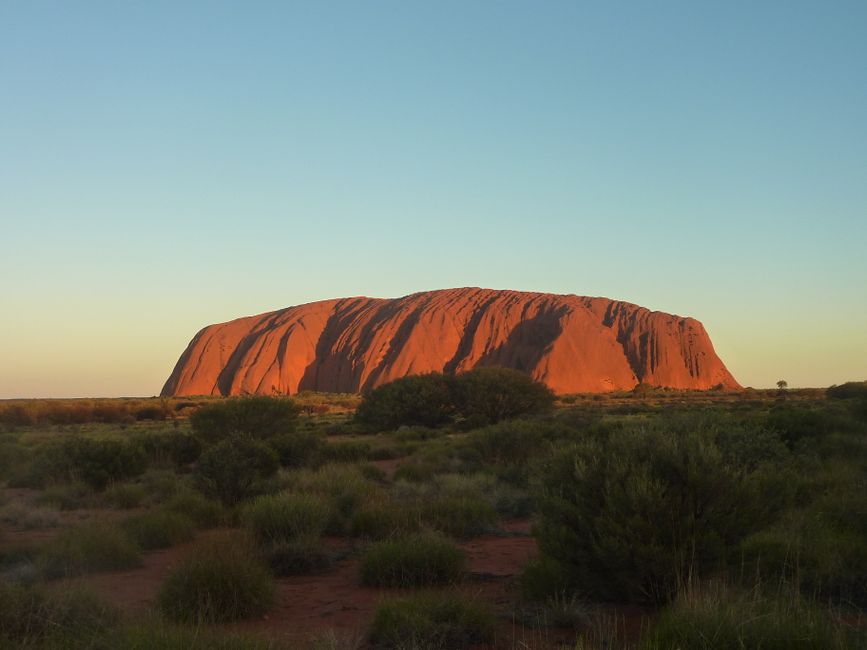
The Red Centre is most comfortable in the cooler months, roughly April to September — desert days are walkable and the sunrises earn their reputation. In the southern summer, the outback regularly runs to temperatures where park authorities close walking tracks by mid-morning; it’s not a heroic season, just a limiting one.
The wildlife calendar
One genuinely magic scheduling fact: humpback whales migrate along both coasts from roughly May to November — heading north in June through August, back south with calves from September to November. If a whale-watching boat is on your list, those months choose your dates for you.
So when would I go?
For a first trip mixing Sydney or Melbourne with the Reef or the north, the sweet spot where both calendars agree is roughly May to October — southern winter-into-spring, northern dry. If your trip is cities and coastline only, September to November and March to May are the gentle, better-value windows. Reef trips, Uluru tours and whale boats are the things that fill up in the dry season — they’re easiest to secure ahead on Klook (or VELTRA for locally operated tours) once your dates are fixed.
For the deeper context — the history and society behind what you’ll see — our Australia country profile is the long read, the power and plug details are the short one, and our travel insurance ranking matters more than usual if the itinerary includes reef swimming or outback drives.
Frequently asked questions
What is the best overall time to visit Australia?
If your trip mixes the southern cities with the Reef or the tropical north, May to October is the window where both calendars agree — the north's dry season overlapping the south's winter and spring. For cities and coastline only, September–November and March–May are the comfortable, better-value shoulders.
When is the wet season in northern Australia?
Roughly November to April across the Top End, the Kimberley and tropical Queensland: monsoonal storms, high humidity, some road closures — and marine stingers along northern coasts that restrict ocean swimming.
When is whale watching season in Australia?
Roughly May to November on both coasts. Humpbacks travel north between June and August and return south with calves from September to November, when southern coastlines see the most activity.
When should I visit Uluru?
The cooler months, roughly April to September, when desert walking is comfortable. In the southern summer, extreme heat regularly closes walking tracks by mid-morning.
Is December to February a good time for Australia?
It's the southern summer: the classic beach season for Sydney and Melbourne, but also peak crowds and prices — and the worst window for the tropical north, which is deep in its wet season.
Keep reading on Gently Yonder
- Airalo vs Holafly vs Saily — The three big travel eSIM providers compared — coverage, pricing, and who each suits.
- Best eSIM for Japan, Korea & Vietnam — Destination-by-destination eSIM picks for three popular Asian countries.
- Pocket WiFi vs eSIM — Which connectivity option wins — solo vs group, cost, battery, and setup compared.
- Hotel Booking Sites Compared — Hotels.com, Booking.com, Trip.com, Agoda — what each is genuinely good for.
- Travel Insurance Compared — SafetyWing vs World Nomads vs Genki — coverage, exclusions, and how to choose.
- Japan Country Profile — Eight-section country deep-dive: history, geography, society, and travel prep.