Australia is a continent, a country, and an island all at once. Sixty-five thousand years of continuous human habitation by Aboriginal and Torres Strait Islander peoples coexist with a country that, in its current federal form, is only 125 years old. The interior is among the driest places on Earth; the coast supports one of the most urbanized populations in the OECD. Every layer is still legible if you know where to look.
§1
Overview
Australia, officially the Commonwealth of Australia, comprises the mainland of the Australian continent, the island of Tasmania, and numerous smaller islands. With a total area of approximately 7,692,024 km², it is the world's sixth- largest country by land area, yet its population of approximately 26 million (2024) makes it one of the most sparsely populated on Earth — roughly 3.4 people per km² [Australian Bureau of Statistics, 2024].
The capital is Canberra, in the Australian Capital Territory. The largest city by population is Sydney, in New South Wales. Other major cities include Melbourne, Brisbane, Perth, and Adelaide. The currency is the Australian dollar (AUD, A$). The official language is English. Australia is a federation of six states and two self-governing territories, and a member of the United Nations, G20, OECD, Commonwealth of Nations, and a number of regional and security organizations including ASEAN dialogue partnerships, the Pacific Islands Forum, and AUKUS.
§2
History
For tens of thousands of years before European contact, the Australian continent was inhabited by Aboriginal and Torres Strait Islander peoples. Archaeological evidence places continuous Indigenous habitation at approximately 65,000 years [Clarkson et al., Nature, 2017], making it among the world's oldest continuous cultures. At the time of European arrival, hundreds of distinct nations and language groups inhabited the continent, with sophisticated knowledge systems for land management — including fire-stick farming — navigation, and astronomy.
Dutch navigators charted parts of the western coast in the 17th century. The British claimed the eastern coast in 1770. The First Fleet arrived at Sydney Cove on 26 January 1788, establishing the first British colony as a penal settlement. Over the following decades, free settlers and the gold rushes of the 1850s–1880s expanded the European population dramatically.
Colonization had devastating impacts on Indigenous Australian populations through disease, dispossession of land, and government policies including the Stolen Generations — children forcibly removed from Aboriginal and Torres Strait Islander families under official policy until the 1970s [Human Rights and Equal Opportunity Commission, Bringing Them Home Report, 1997].
The six Australian colonies federated into the Commonwealth of Australia on 1 January 1901. Australia participated in both World Wars; the ANZAC tradition originating in the 1915 Gallipoli campaign remains central to national commemoration. Post-1945 immigration transformed Australian demographics, initially from Europe and subsequently from Asia, the Middle East, and Africa.
Key milestones in reconciliation include the 1967 referendum (which gave the federal Parliament power to legislate for Indigenous Australians and counted them in the census), the 1992 Mabo decision (which overturned the legal doctrine of terra nullius and recognized Native Title), the 2008 National Apology to the Stolen Generations, and the 2023 referendum on a constitutionally enshrined Indigenous Voice to Parliament. The reconciliation process is ongoing.
§3
Geography
Australia is the smallest of the world's continents but the sixth-largest country. It is surrounded by the Indian Ocean to the west and south and the Pacific Ocean to the east. The interior is dominated by the Outback — vast arid and semi-arid plains including the Great Victoria Desert, the Great Sandy Desert, and the Simpson Desert.
The Great Dividing Range runs along the eastern coast, separating fertile coastal plains from the interior. The fertile southeast — including the Murray–Darling river system — supports much of Australian agriculture. Most of the population lives within 100 km of the coast.
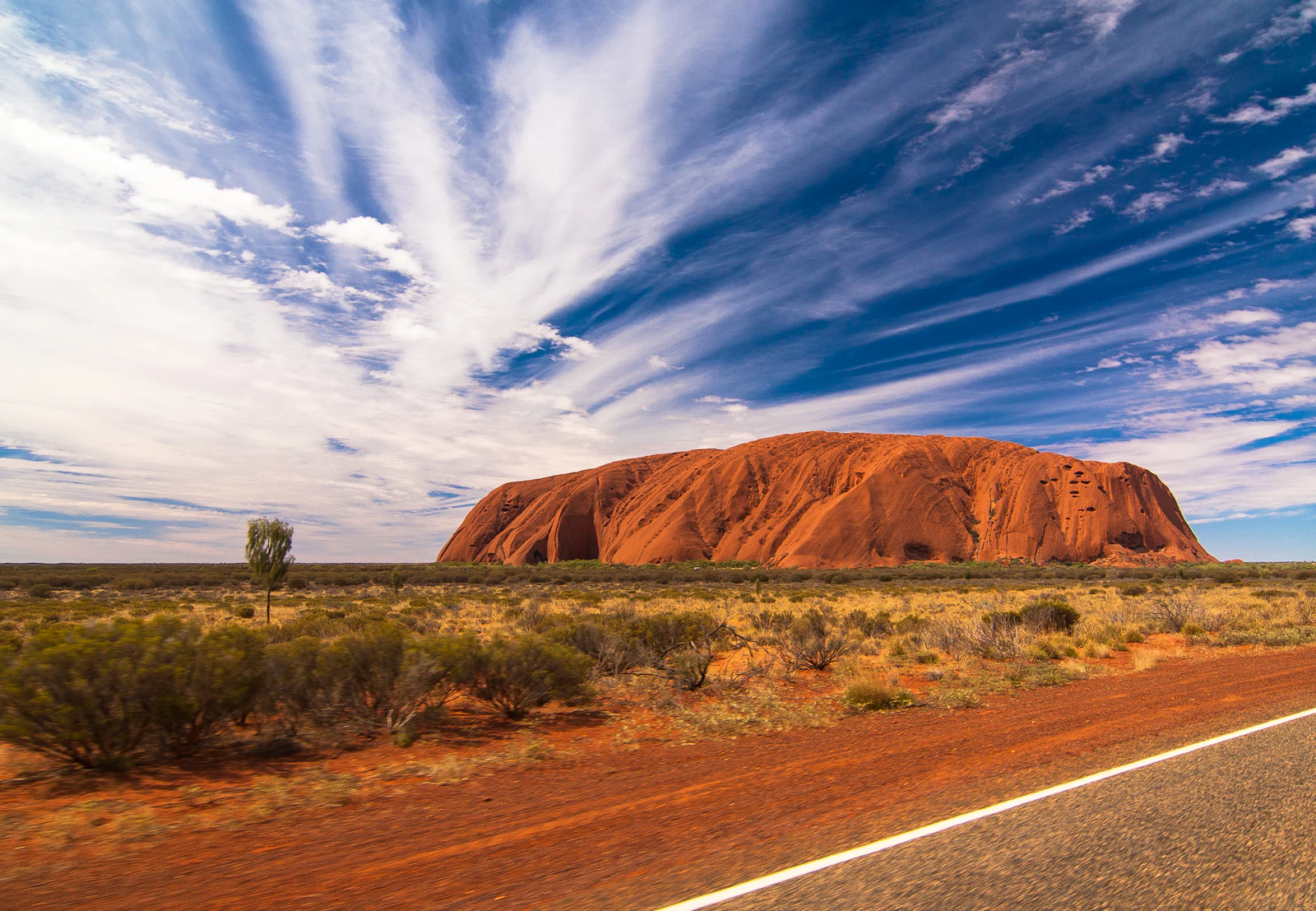
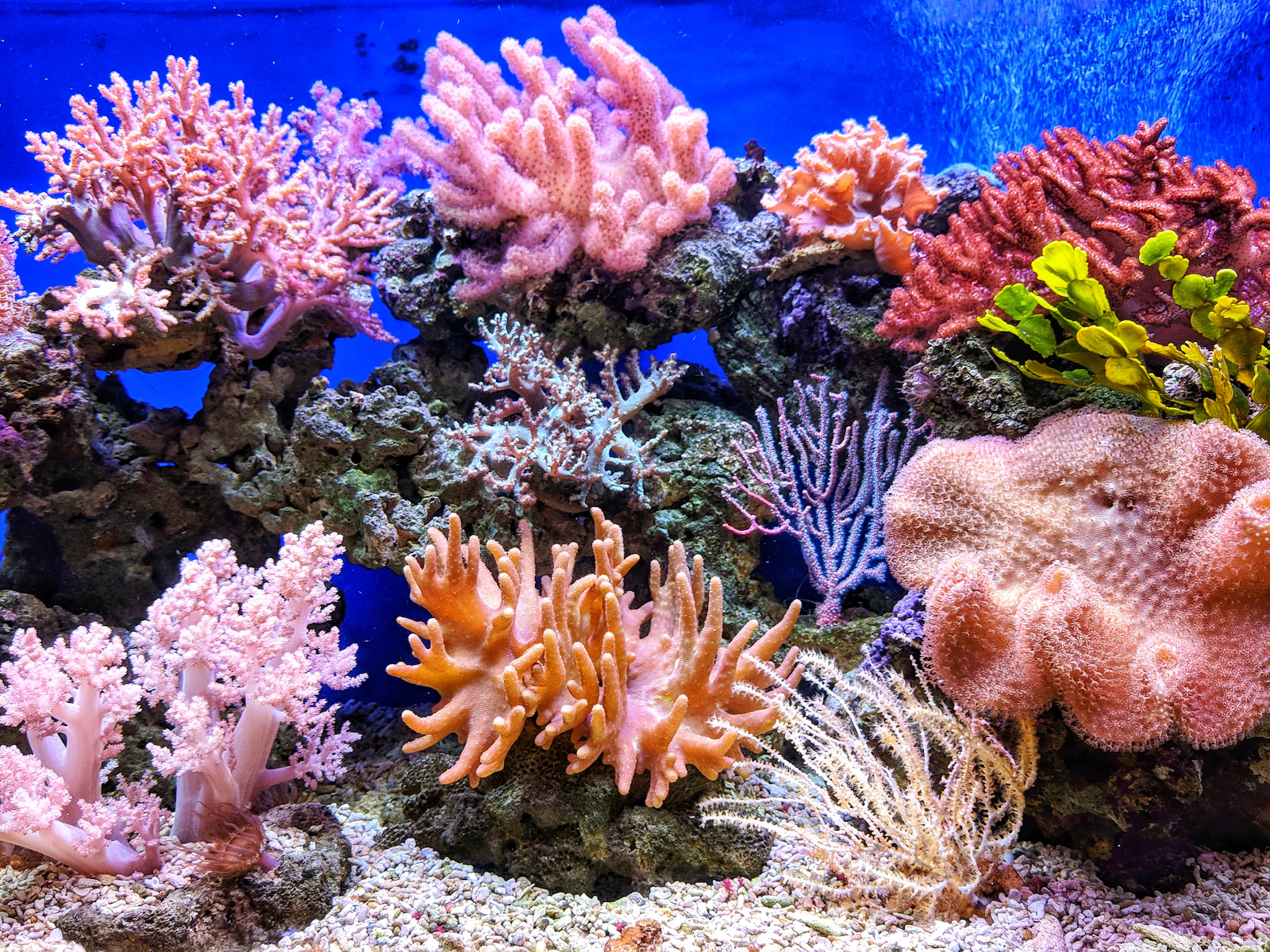
The Great Barrier Reef, off the Queensland coast, is the world's largest coral reef system at approximately 2,300 km long. It has been UNESCO-listed since 1981. Uluru (Ayers Rock) in the Northern Territory is among the world's most recognizable monoliths and a site of profound cultural significance to the Anangu people [Uluru-Kata Tjuta National Park documentation].
Climate varies sharply: tropical monsoon in the far north (Cairns, Darwin), arid in the interior, temperate in the south (Melbourne, Hobart). Seasons are inverted from the Northern Hemisphere — December to February is summer; June to August is winter. UV intensity is among the world's highest year-round, particularly in the north [Australian Radiation Protection and Nuclear Safety Agency (ARPANSA)].
§4
Politics
Australia is a constitutional monarchy and a federal parliamentary democracy. King Charles III is the head of state, represented in Australia by the Governor-General. Practical executive power rests with the Prime Minister, who leads the government drawn from the majority in the House of Representatives.
The Parliament of Australia is bicameral, comprising the House of Representatives (lower house, 151 seats elected from single-member districts) and the Senate (upper house, 76 seats elected by proportional representation from state-based constituencies). Six states (New South Wales, Victoria, Queensland, Western Australia, South Australia, Tasmania) and two self-governing territories (Australian Capital Territory, Northern Territory) each have their own parliaments and governments.
Two major political groupings have dominated federal politics since the mid-20th century: the Australian Labor Party (centre-left) and the Liberal– National Coalition (centre-right). Voting has been compulsory in federal elections since 1924 — one of approximately twenty countries with mandatory voting [International Institute for Democracy and Electoral Assistance (IDEA)].
Australia's foreign policy emphasizes regional engagement (ASEAN dialogue partnership, Pacific Islands Forum) alongside security alliances including ANZUS (with the United States and New Zealand), the Five Eyes intelligence partnership, AUKUS (with the United Kingdom and United States), and the Quad (with the United States, Japan, and India) [Australian Department of Foreign Affairs and Trade].
§5
Economy & Industry
Australia has one of the world's largest economies by nominal GDP, with a high GDP per capita reflecting its mineral wealth, diversified service sector, and stable institutional environment. Mining and energy are major export sectors — Australia is the world's largest exporter of iron ore, and a leading exporter of coal, liquefied natural gas (LNG), and gold [Department of Industry, Science and Resources, Resources and Energy Quarterly].
China is Australia's largest single trading partner, particularly for iron ore and other commodity exports. Japan, South Korea, and the United States are among other major trade partners. Agriculture accounts for roughly 2 percent of GDP but is internationally significant: Australia is a major exporter of wheat, beef, wool, dairy, and wine.
The service sector accounts for approximately 70 percent of GDP, including finance, professional services, education, and tourism. Major financial centres are Sydney and Melbourne. International education is a significant export, with substantial student inflows particularly from China, India, and Southeast Asia [Department of Education, Australia].
Contemporary economic challenges include some of the world's least affordable housing markets — Sydney and Melbourne consistently rank among the most expensive globally relative to income [Demographia International Housing Affordability Survey] — cost-of-living pressures, and the long-term transition from carbon-intensive industries.
§6
People & Languages
Australia has one of the world's most diverse populations relative to its size. Approximately 30 percent of residents were born overseas — among the highest proportions in the OECD [OECD International Migration Outlook]. Major diaspora communities include those from the United Kingdom, India, China, New Zealand, the Philippines, Vietnam, Italy, Greece, Lebanon, and rapidly growing populations from across Africa.
Aboriginal and Torres Strait Islander peoples comprise approximately 3.8 percent of the population. Originally hundreds of distinct nations with their own languages, contemporary Indigenous communities continue work toward language revitalization — approximately 120 Indigenous languages are still spoken, though many are critically endangered [AIATSIS — Australian Institute of Aboriginal and Torres Strait Islander Studies].
The official language is English, in its distinctive Australian variety. Multilingual communities are common in major cities: Mandarin, Arabic, Vietnamese, Cantonese, Italian, and Greek are among the most widely spoken home languages after English.
Religious affiliation is plural and declining. In the most recent census, approximately 44 percent identified as Christian (across multiple denominations), approximately 10 percent as adherents of other religions (Islam, Hinduism, Buddhism, Sikhism among them), and roughly 39 percent as having no religion — one of the highest proportions globally [Australian Bureau of Statistics Census 2021].
§7
Society
Australia ranks consistently high on quality-of-life indices: life expectancy of approximately 83 years [WHO World Health Statistics], universal healthcare via Medicare, robust social welfare, and strong educational outcomes. Approximately 86 percent of Australians live in urban areas, with most population concentrated in a handful of coastal cities.
Work-life balance is culturally valued and supported by relatively generous statutory leave entitlements. Outdoor lifestyle is central to social life in many regions: beach culture, surfing, hiking, camping, and the barbecue (locally "barbie") are common features.
Coffee culture is particularly developed in Melbourne, which has shaped global café trends — the flat white, now international, is widely considered an Australian (or Australia-NZ) invention. Australian fusion cuisine, influenced by successive waves of immigration, has also become internationally influential.
Sport is a significant cultural force. Cricket, Australian Rules Football (AFL), rugby league and union, soccer, swimming, surfing, and tennis all command substantial followings. Major sporting events — the Australian Open tennis, the AFL Grand Final, the Melbourne Cup horse race — are national occasions [Australian Sports Commission].
§8
Culture
Australian culture is layered: Indigenous, British colonial, post-war European, and contemporary multicultural Asian influences all coexist. The result is a distinctive synthesis rather than a single dominant tradition.
Indigenous Australian art represents one of the world's oldest continuous artistic traditions. Rock art at Kakadu National Park dates back at least 20,000 years [Australian Heritage Database]. Contemporary Indigenous painting — particularly the dot painting traditions of the Western Desert that emerged at Papunya in the early 1970s — is internationally significant in the modern art world.
Australian cinema has produced internationally recognized work, from Picnic at Hanging Rock (1975) and Mad Max (1979) to Crocodile Dundee (1986), Lantana (2001), The Babadook (2014), and Hacksaw Ridge (2016). Filmmakers including Peter Weir, Baz Luhrmann, George Miller, and Jane Campion have shaped global cinema.
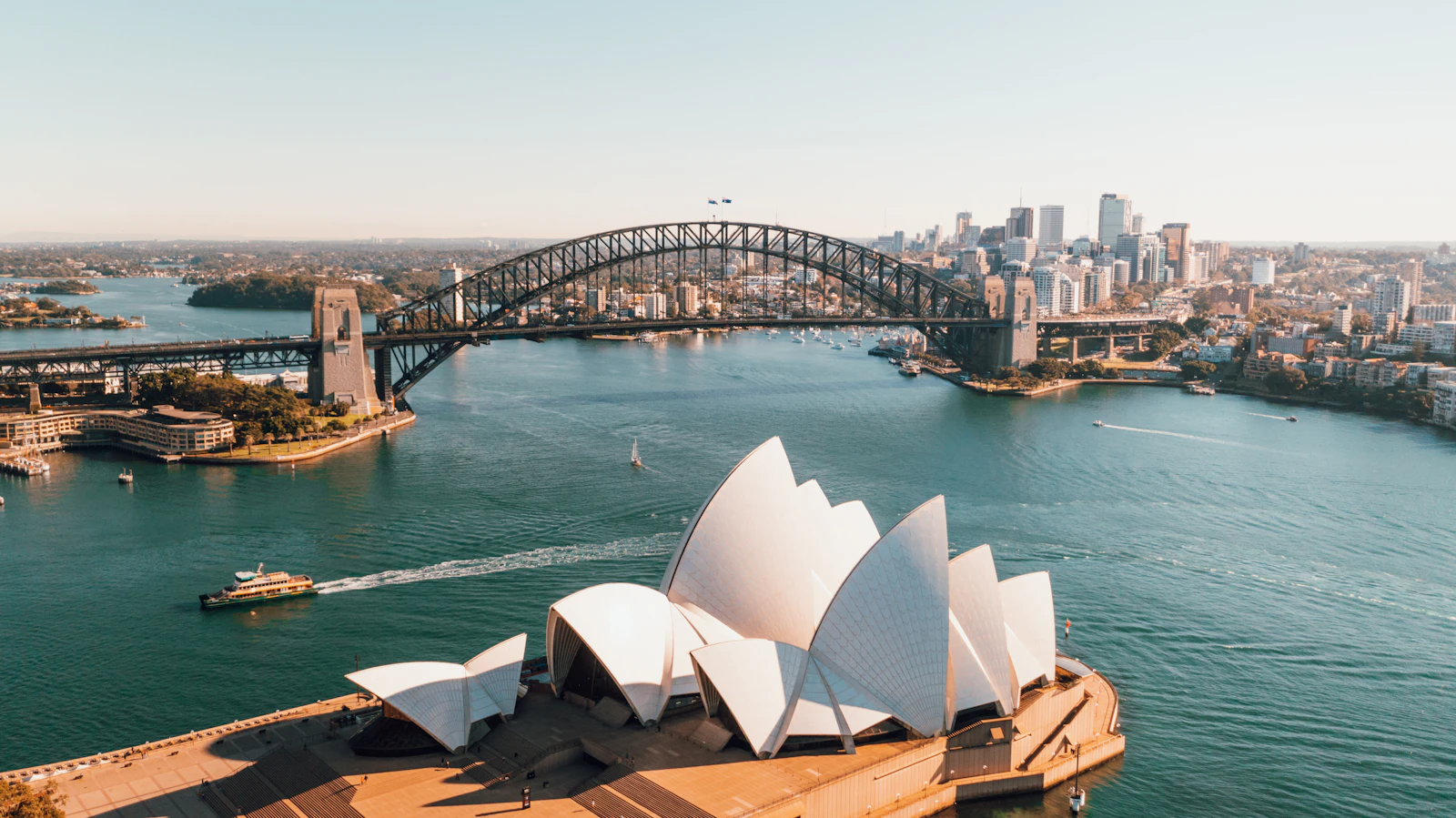
Australian music has produced internationally significant artists across generations: AC/DC, INXS, Crowded House, Nick Cave, Kylie Minogue, Tame Impala, Sia, and others. The Sydney Opera House — designed by the Danish architect Jørn Utzon, completed in 1973, UNESCO-listed in 2007 — is a global architectural icon.
Australian literature includes Nobel Prize laureate Patrick White (1973) and multiple Booker Prize winners (Peter Carey, Thomas Keneally, Richard Flanagan, DBC Pierre). Indigenous storytelling traditions, spanning oral tradition and contemporary written work, are increasingly recognized internationally.
UNESCO World Heritage Sites within Australia include the Great Barrier Reef (1981), Kakadu National Park (1981), the Willandra Lakes Region (1981), Lord Howe Island Group (1982), the Tasmanian Wilderness (1982), Uluru-Kata Tjuta National Park (1987), the Sydney Opera House (2007), and others [UNESCO World Heritage List].
Travel prep for Australia
A few practical items to sort before flying. Long flights, unusual plug, intense sun, and strict biosecurity — small preparation saves real time on the ground.
Universal travel adapter
Australia uses Type I plugs (230V, 50Hz). A universal adapter covers Australia plus most other destinations on the same trip.
View optionsCompression socks
Helpful on the long flights into Australia (10–22 hours from most origin cities). May reduce leg swelling on long-haul flights.
View optionsReef-safe sunscreen
Australia has among the highest UV intensities on Earth. Reef-safe formulations are appropriate for Great Barrier Reef visits.
View optionsKlook — tours, tickets, and transfers across Asia
Strong coverage in Japan, Korea, Vietnam, Thailand, Hong Kong, Taiwan, and Singapore. Skip-the-line tickets, day tours, airport transfers, and pocket Wi-Fi. Often the cheapest reliable option for major attractions in Asian capitals.
Browse Klook tours & tickets →For deeper preparation, see our practical Gently Yonder guides:
- eSIM Setup for International Travel — arrival-ready connectivity for Australia.
- Where to stay in Sydney — six areas and 13 hotels, including one we stayed at.
- Where to stay in Melbourne — five areas and 12 hotels, and why the CBD suits a first trip.
- Hotel Booking Sites Compared — what each booking site is good for.
- Carry-On Packing for Airport Security — essential for long-haul.
- Beach Trip Packing Checklist — for the Great Barrier Reef and coastal destinations.
- Trip Checklist Generator — build a personalised checklist for your specific Australia trip.
Disclosure: Some links above are affiliate links. As an Amazon Associate, Travel Now may earn from qualifying purchases at no extra cost to you. Affiliate links appear only in this practical section, not within historical, political, or cultural content.
Experiences worth booking ahead in Sydney & Melbourne
Top-rated tours and activities — book skip-the-line where possible:
Where to go next on Gently Yonder
- Where to Stay in Sydney — the city centre, the harbour, Surry Hills or the beach: six areas compared.
- Where to Stay in Melbourne — the CBD, Southbank, Fitzroy, St Kilda or South Yarra.
- Best eSIM for Australia (2026) — data sizes, the outback coverage question, and the honest pick.
- Melbourne Airport to the City — SkyBus, taxi, or the AU$6 Myki route; there is no airport train.
- Travel Insurance for Australia — what matters, and who can rely on reciprocal Medicare access.
- Japan country profile — the same 8-section format applied to East Asia.
- Vietnam country profile — Southeast Asia layered.
- eSIM Setup for International Travel — practical connectivity prep.
- Hotel Booking Sites Compared — choosing between platforms.
Sources & further reading
- Australian Bureau of Statistics (ABS). Population and Housing Census (2021) and current population estimates.
- Clarkson, C. et al. "Human occupation of northern Australia by 65,000 years ago." Nature, vol. 547, 2017.
- Human Rights and Equal Opportunity Commission. Bringing Them Home: Report of the National Inquiry into the Separation of Aboriginal and Torres Strait Islander Children from Their Families, 1997.
- Australian Institute of Aboriginal and Torres Strait Islander Studies (AIATSIS). Language and cultural documentation.
- Department of Industry, Science and Resources (Australia). Resources and Energy Quarterly.
- Department of Education (Australia). International education statistics.
- OECD. International Migration Outlook — Australia entries.
- Australian Department of Foreign Affairs and Trade. Foreign policy and trade documentation.
- Australian Radiation Protection and Nuclear Safety Agency (ARPANSA). UV index and sun exposure data.
- UNESCO. World Heritage List — Australian site documentation.
- Macintyre, S. A Concise History of Australia. 4th ed., Cambridge University Press, 2020.
- Pascoe, B. Dark Emu: Aboriginal Australia and the Birth of Agriculture. Magabala Books, 2014.
- Reynolds, H. Truth-Telling: History, Sovereignty and the Uluru Statement. NewSouth, 2021.
- International IDEA. Compulsory Voting database and analysis.