No one pays to be recommended here, and we say when a free or cheaper option wins. Our promise →
In this guide8 sections
Ask five people the best time to visit Japan and you’ll get five confident answers, all different, all half-right. The honest version is that Japan has four genuinely distinct trips inside one country, and the “best” one depends on what you’re willing to trade: color for crowds, comfort for cost. Here’s the whole year, plainly.
Spring: the famous two weeks

The cherry blossom window is real and really short. For 2026, the Japan Meteorological Corporation’s early forecast has Tokyo flowering around March 21 with full bloom near March 28, and Kyoto peaking around April 2 — forecasts firm up as the season nears, so check a current one before you book flights around a specific week. Two honest cautions: this is the year’s biggest crowd and its steepest pricing (accommodation premiums of 150–200% are common, and the popular hotels book out 6–9 months ahead), and the bloom does not consult anyone’s itinerary. If you go, go for the atmosphere of the season rather than a guaranteed photograph, and you’ll come home happy either way.
It helps to know that the bloom is not one national event but a wave. It typically opens in the south — Fukuoka and the rest of Kyushu often see flowers in late March — reaches Tokyo and Kyoto around the turn of the month, moves through the mountains and Tohoku across April, and arrives in Hokkaido around early May. That geography is your safety net: miss Kyoto’s peak by a week and you can often still catch full bloom further north, and chasing the front up the country is a perfectly legitimate itinerary. If you would rather trade fame for quiet entirely, the plum blossoms of February and early March — ume, at shrines such as Kyoto’s Kitano Tenmangū — carry much of the same feeling with a fraction of the audience.
What surprises first-timers most is that hanami is a participant sport, not a spectacle. Parks fill with picnic sheets, office parties, and families staking out spots beneath the trees; convenience stores go seasonal from the snacks to the drinks; and after dark, lantern-lit yozakura — evening blossom viewing — turns whole neighbourhoods gently festive. You don’t so much watch this season as join it, which is exactly why a trip built around one photograph undersells what is actually on offer.
The dates to plan around
Three domestic holiday periods compress the whole country’s travel into a few days: Golden Week (April 29 to May 6 in 2026), Obon in mid-August, and the New Year period. Golden Week is a cluster of national holidays that becomes, in practice, a nationwide week off; Obon is when families return to their home towns to honour their ancestors — culturally fascinating, logistically intense. Trains, hotels and highways fill with Japan itself on the move.
Travelling in a peak week? Book the room first: where to stay in Japan on a first trip splits the nights, our guides to Tokyo, Kyoto and Osaka name the hotels, and our cherry-blossom guides to Tokyo and Kyoto have the dates and the areas by blossom, as our Sapporo Snow Festival guide does for February.
None of this makes the country unvisitable on those dates; it just changes the rules. Avoid the long-distance trains on the first and last days of each window, book anything that sleeps or rolls well ahead if you must overlap them, and expect the famous sights at their fullest. Unless those dates are your only option, though, plan just before or after — mid-May in particular is a quietly excellent window: spring warmth, fresh green, and the Golden Week crowds gone home.
Summer: festivals, heat, and a wet June
June into mid-July brings tsuyu, the rainy season — grey, humid, and not the disaster people imagine (hydrangeas at temple gates are their own reward). High summer is hot and humid in a way that shapes your days: mornings and evenings out, air-conditioned museums and department stores in the punishing middle hours, and a conbini drink always in hand.

The compensation is a festival calendar worth planning around. Kyoto gives the whole of July to Gion Matsuri, one of Japan’s oldest festivals, with grand float processions on July 17 and 24 and lantern-lit evening streets in the nights before each. Tokyo’s Sumida River fireworks usually light up a late-July Saturday; early August brings the illuminated floats of Aomori’s Nebuta Matsuri; and in mid-August Tokushima’s Awa Odori turns Obon into street-filling dance. If the heat itself is what worries you, do what many Japanese travellers do and go north — Hokkaido’s summer is noticeably milder, and the lavender fields around Furano peak in July.
One honest caveat for late summer: August through October is typhoon season. Most storms cost travellers a day of flexibility rather than a trip, but this is the season when travel insurance genuinely earns its small line in the budget — we compare policies in our Japan travel insurance guide, or you can price cover with EKTA in a few minutes — and when island or coastal plans deserve a plan B. Watch forecasts, build slack, and don’t let it scare you off the country.
Autumn: spring’s equal, with better weather
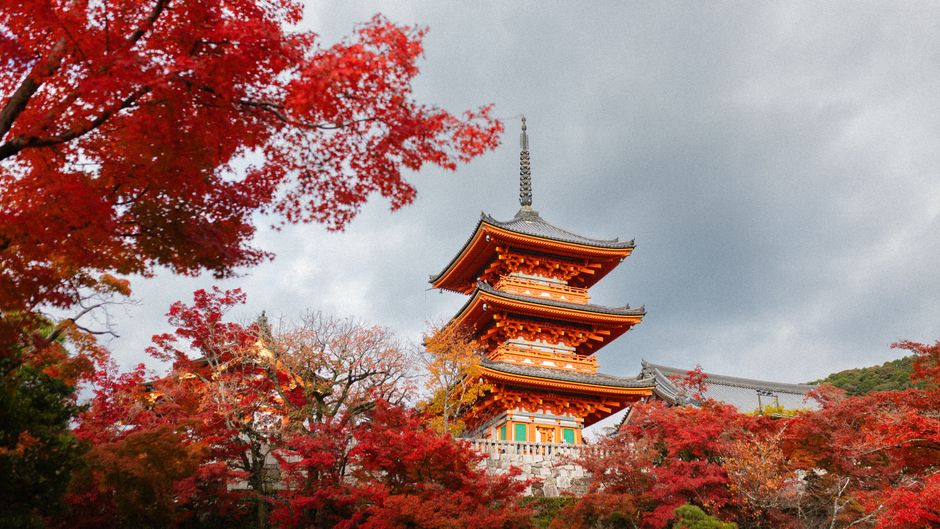
October is arguably the year’s most comfortable month — mild, clear, with the foliage just beginning. November is peak color in most of the famous places and has become the second most expensive month after April, which tells you how many people have figured this out. We wrote a dedicated guide to Japan’s autumn 2026 — including what books out and when — because it deserves one.
Autumn runs opposite to spring: the colour starts in Hokkaido’s high country around late September and flows south, reaching the gardens of Tokyo and the temples of Kyoto in the second half of November and often holding into early December. That late timing trips people up — book a “fall foliage” trip for early October and, in the famous cities, you will mostly find green. Early-October travellers should aim at altitude instead: Nikko’s shrines and lakes, and the mountain onsen towns, colour weeks ahead of the lowland cities. By November, Kyoto’s great temples open for evening illuminations of their maple gardens, and the queues tell you how loved they are — our Kyoto autumn guide covers the booking realities. There is a particular kind of quiet in a temple garden on a cold, clear November morning, before the day’s buses arrive, that I would put against any week of spring.
Winter: the honest bargain
December through mid-March is Japan at its cheapest and least crowded (holidays aside): crisp blue Tokyo days, snow country an easy train ride away, and hot springs at their most persuasive. If your goal is Japan itself rather than a specific bloom or leaf, winter is the value answer almost nobody takes.

The season has its own icons, too. Sapporo’s Snow Festival fills Ōdōri Park with snow sculptures in early February; the snow monkeys of Jigokudani, in the Nagano mountains, soak in their hot spring most photogenically in the cold months; skiers cross the world for the powder of Niseko and Hakuba; illuminations run in the cities from November into February; and the clear winter air gives the year’s most reliable views of Mount Fuji from the Tokyo side. A snowfall in Kyoto is rare enough to be an event — locals head straight for Kinkaku-ji, gold against white, and it is worth doing the same if you are lucky.
Two cautions keep winter honest. The New Year period — roughly December 29 to January 3 — is its own domestic peak, when millions make hatsumōde shrine visits in the first days of January and many restaurants and sights close or shorten hours. And a snow-country itinerary needs looser connections than a city one; give the weather room to have opinions.
The year at a glance
| Month | The short version | Crowds & cost |
|---|---|---|
| January | Crisp, clear city days; snow country in full swing | Low, once New Year ends |
| February | Coldest month; Sapporo Snow Festival; plum blossoms begin | Low, ski towns aside |
| March | Plum gives way to cherry; blossoms open in the south, Tokyo late in the month | Climbing fast |
| April | Full bloom moving north; Japan at its most photographed | The year’s peak; Golden Week starts April 29 |
| May | Fresh green and mild days once Golden Week ends | Lovely and calmer after May 6 |
| June | Tsuyu rains; hydrangeas; gardens at their greenest | Quiet, good value |
| July | Hot and humid; Gion Matsuri; Hokkaido at its best | Moderate; festival dates spike locally |
| August | Peak heat; fireworks and Obon dances; typhoon watch begins | Obon mid-month is a domestic peak |
| September | Heat easing; the heart of typhoon season | Quieter; stay flexible |
| October | Arguably the most comfortable month; early colour at altitude | Building steadily |
| November | Peak foliage in the famous places; temple illuminations | Second only to April |
| December | Illuminations, first snow, quiet streets | Low — until the New Year rush |
So when should you go?
For a first trip with flexible dates, May or October–November balance weather, color and sanity best. For the famous seasons, book far ahead and lock the tickets that sell out the day your dates fix — and price the JR Pass math before assuming you need one. Experiences in the peak windows are easiest to secure ahead on Klook (or VELTRA for locally operated tours). However you time it, our Japan eSIM guide makes sure you land connected, and our 7-day first-timer’s itinerary turns the chosen week into an actual plan.
Japan doesn’t have a wrong season. It has four different countries wearing the same name, and the calm move is choosing which one you actually want to meet.
Frequently asked questions
When do cherry blossoms bloom in Japan in 2026?
Early forecasts from the Japan Meteorological Corporation put Tokyo's flowering around March 21 with full bloom near March 28, and Kyoto peaking around April 2. Forecasts are updated as the season approaches, so check a current one before booking around a specific week.
What dates should I avoid in Japan in 2026?
The big domestic travel peaks: Golden Week (about April 29 to May 6, 2026), Obon in mid-August, and the New Year period. Trains and hotels fill with domestic travelers and prices rise sharply.
Is the rainy season a bad time to visit Japan?
June to mid-July is humid and grey, but it's quieter and cheaper, and gardens are at their greenest. It's a trade rather than a mistake — just plan more indoor and covered options.
What is the cheapest time to visit Japan?
Winter, from December to mid-March (avoiding the New Year period), is generally the cheapest and least crowded stretch, with crisp clear days in the cities and easy access to snow country and hot springs.
Is autumn or spring better for a first Japan trip?
Autumn tends to offer more comfortable, drier weather with foliage that rivals the blossoms, while spring offers the famous sakura atmosphere at the cost of the year's biggest crowds and prices. For flexible dates, May and October–November balance everything best.
Keep reading on Gently Yonder
- Where to Stay in Sapporo for the Snow Festival The 2027 dates and sites, four areas and 10 hotels, the new hotel tax, and one hotel that closes after the festival.
- Where to Stay in Tokyo for Cherry Blossom The dates to aim for, five areas matched to the parks and rivers, 14 hotels, and the tax change on 1 April 2027.
- Where to Stay in Kyoto for Cherry Blossom The dates to aim for, five areas matched to the blossom walks, 12 hotels, and how to book now for 2027.
- Japan in Autumn 2026 Foliage timing city by city, crowd patterns, and how to plan around both.
- Kyoto in Autumn 2026 Where the colors peak and when — temples, timing, and quieter alternatives.
- Japan Tickets That Sell Out: What to Book Before You Fly Ghibli, teamLab, Shibuya Sky and the rest — what actually sells out and when to book.
- Japan: A 7-Day First-Timer's Itinerary Three days in Tokyo, a day trip, two days in Kyoto, and a day in Osaka — tied together by the Shinkansen.
- Japan Country Profile Eight-section country deep-dive: history, geography, society, and travel prep.