Seven days is not enough for Japan — nothing is — but it is exactly enough for a first, unforgettable taste of its two great poles: the neon energy of Tokyo and the temple-quiet of Kyoto, with a day of Osaka’s appetite and a mountain or a deer park in between. This itinerary is built to be easy: it uses the country’s superb trains, keeps backtracking to a minimum, and leaves room to wander. Before you go, two things make everything smoother — a travel eSIM so maps and train apps work from the airport, and a browse of Klook or KKday for teamLab, the Shinkansen, and JR passes, which are cheaper and less stressful arranged ahead.
No one pays to be recommended here, and we say when a free or cheaper option wins. Our promise →
In this guide8 sections
Before you land: the bookings that matter

A week this short rewards a little front-loading, so here is the honest priority order. Flights first — start watching fares early across a whole month of dates (Aviasales makes the comparison painless), and if you can, fly into Tokyo and home from Osaka’s Kansai airport so the itinerary never backtracks. Accommodation second, and genuinely early if your dates touch cherry blossom or November foliage — the well-located mid-range places sell out months ahead in those windows, as our season guide explains.
Where to sleep on this route: how to split the nights, then our guides to Tokyo, Kyoto and Osaka, which compare the areas and name the hotels.
Timed tickets third: a handful of Tokyo experiences — teamLab, Shibuya Sky, the Ghibli Museum — sell out ahead of time and cannot be fixed on arrival; our book-in-advance guide lists what locks up and when. Rail fourth: for this exact route the ¥50,000 JR Pass usually does not pay — a Tokyo–Kyoto round trip is only about ¥28,000 — so run your route through our JR Pass maths before buying anything. Last, the small stuff that smooths everything: the eSIM from the introduction, and travel insurance (a quote from EKTA takes minutes; our Japan insurance guide explains the cover that actually matters).
Days 1–3: Tokyo

You will land at one of two airports: Haneda, mercifully close to the city, or Narita, about an hour out by express train — our airport-to-city guide compares every route, and our first-day arrival plan walks you through the jet-lagged opening hours, from airport SIM counters you can skip (your eSIM already works) to the IC card that unlocks every train.
Base yourself centrally (Shinjuku or Shibuya are ideal) and give the capital three days. Day 1, ease in around the old east: Senso-ji, Tokyo’s oldest temple, approached through the souvenir stalls of Nakamise-dōri — go before nine and you will have the incense and the lantern gate mostly to yourself — then a river cruise and the view from the Tokyo Skytree. Day 2, take on the west: the Shibuya Scramble and Shibuya Sky, the youth theatre of Harajuku’s Takeshita-dōri against the century-old planted forest of Meiji Jingu next door — the single best five-minute mood swing in Tokyo — then neon-lit Shinjuku after dark, where dinner belongs in the lantern-lit alleys of Omoide Yokochō or a matchbox bar in Golden Gai. Day 3, mix a booked teamLab visit (Planets in Toyosu or Borderless in Azabudai Hills — both need advance tickets) with Ueno’s museums — the Tokyo National Museum is the country’s greatest attic — the market bustle of Ameyoko, or the electric sprawl of Akihabara — and eat everything. Our full guide to the city, Tokyo: The Places Worth Your Time, lays out the options in detail.
Day 4: A day trip, then west

On your fourth morning, take a classic day trip while still based in Tokyo. Kamakura is the seaside option: the Great Buddha sitting open-air at Kōtoku-in, the hillside terraces of Hase-dera, and the little Enoden line rattling along the coast between them. Nikko is the mountain option — the lavishly carved shrines of Tōshō-gū under giant cedars. Hakone is the classic loop of switchback railway, ropeway, and a boat across Lake Ashi, with hot springs at the end and, on a clear day, Mount Fuji in the water. Pick one; all three are excellent, and choosing is part of the trip.
Two luggage tricks make this transition day painless. Send your big suitcase ahead from your Tokyo hotel to your Kyoto one by takkyūbin luggage forwarding — roughly ¥2,000–3,000 a bag, usually arriving next day — and travel the Shinkansen with a daypack; or if you would rather keep the bag, our Tokyo luggage-storage guide covers the lockers and drop-off options. Then, in the late afternoon, ride the Shinkansen west toward Kyoto (about two and a quarter hours) — reserve a seat on the right-hand side and, if the weather is kind, watch Fuji slide past your window.
Days 5–6: Kyoto

Give Japan’s old capital two full days, and start each one early — the single golden rule of Kyoto is to beat the tour buses, and it costs nothing but an alarm. Day 5, walk the thousand vermilion gates of Fushimi Inari at dawn; the shrine grounds are free and never close, and the difference between seven and ten in the morning is the difference between a pilgrimage and a queue. There is a particular hush on the mountain early — wet stone, birdsong, the gates deepening from orange to ember as the light comes up — that I would trade almost anything else in this itinerary to keep. Then the eastern hills: Kiyomizu-dera, open from six in the morning, its wooden stage hanging over the valley, and the preserved slopes of Sannenzaka and Ninenzaka funnelling you gently downhill. End the day in the geisha district of Gion as the lanterns come on — our Gion neighbourhood guide covers the etiquette and the streets worth your evening.
Day 6, head west to Arashiyama: the bamboo grove first thing, the World Heritage gardens of Tenryū-ji beside it, and the Togetsukyō bridge over the river. Cross town to the Golden Pavilion (Kinkaku-ji) — smaller than you expect and more beautiful than the photographs — then browse Nishiki Market, Kyoto’s covered food street, for a grazing late lunch. Our Kyoto: The Places Worth Your Time guide maps it all in detail.
Day 7: Osaka (and Nara, if you can)
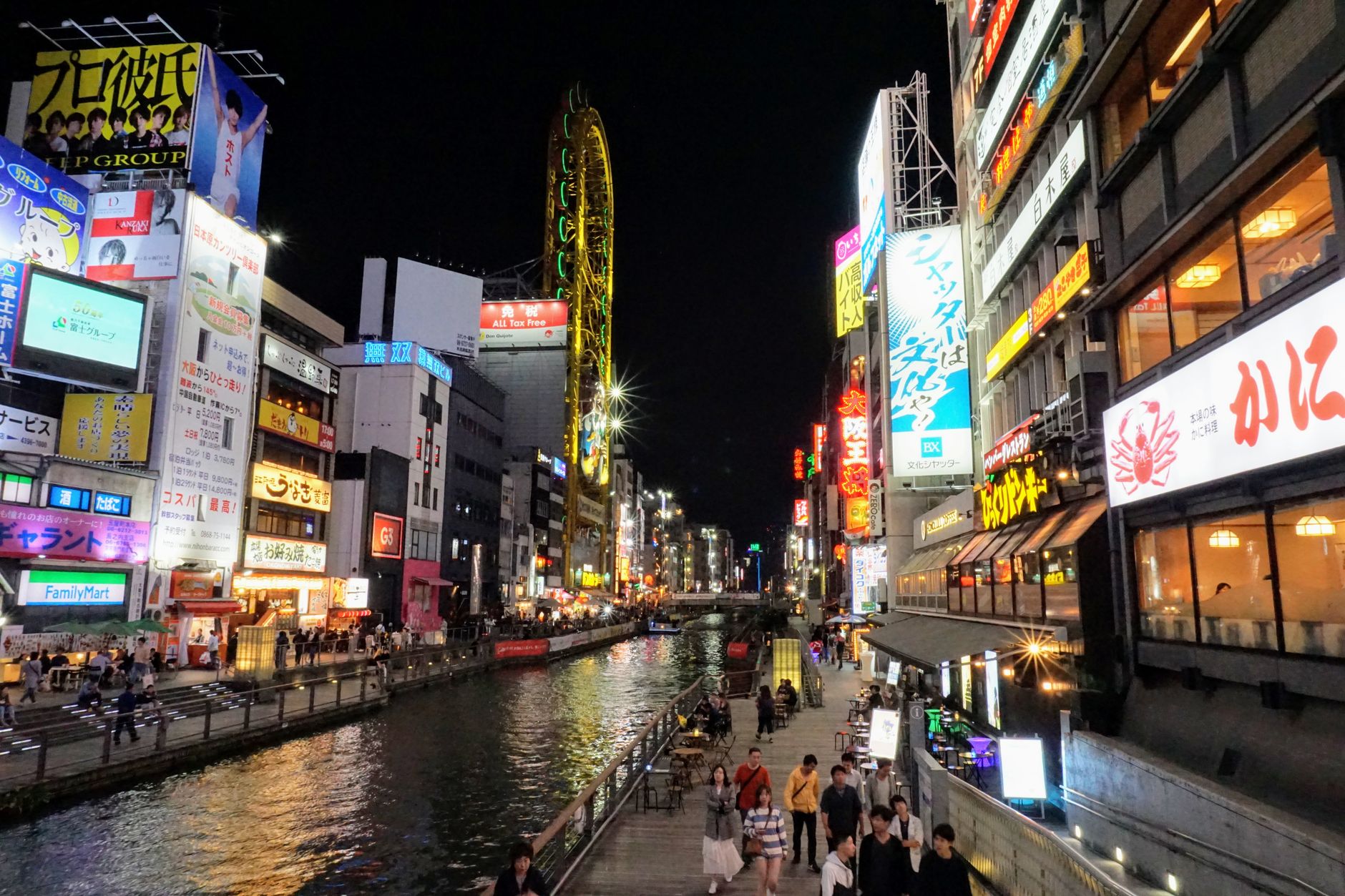
For your final day, ride 15 minutes from Kyoto to Osaka, Japan’s warm, hungry kitchen. If you have the morning to spare, detour first to Nara (45 minutes) for the Great Buddha of Todaiji — cast in the eighth century and still startling in scale — and the park’s famous deer, who bow for crackers with varying degrees of patience. Then give Osaka the afternoon and evening: the food stalls of Kuromon Ichiba market, the retro streets of Shinsekai under the Tsūtenkaku tower for kushikatsu (deep-fried skewers with a communal sauce and one sacred rule — no double-dipping), and finally the canal-side neon of Dotonbori, where you find the Glico running man, graze takoyaki and okonomiyaki, and let the city’s appetite close your week — see Osaka: The Places Worth Your Time. Fly home from Osaka’s Kansai airport, or loop back to Tokyo on the Shinkansen.
If you have more than seven days
The most common regret I hear from first-timers is not a missed sight but a rushed pace, so with extra days my first advice is to spend them exactly where you already are: a third Kyoto day for the Philosopher’s Path and the northern temples, or a Tokyo neighbourhood you surrendered. If you want new ground instead, Hiroshima is around ninety minutes beyond Osaka by Shinkansen — the Peace Memorial Park asks for unhurried time, and the floating torii of Miyajima is an easy ferry add-on — and it pairs naturally with the western route home from Kansai. An overnight in a Hakone or Kinosaki onsen ryokan, dinner and breakfast included, is the other classic upgrade — the one night of the trip that feels least like travel and most like arrival.
Making it easy: transport and timing
The Shinkansen ties this trip together; a Japan Rail Pass can pay off if you also loop back to Tokyo, though with recent price rises it is worth doing the maths for your exact route — we did them here. In the cities, tap through on an IC card — Suica, ICOCA, or simply your phone; our IC card guide takes five minutes and saves you from ever queuing at a ticket machine. Carry a modest cash float alongside the cards (our cash guide explains how much and where to top up), and budget the week honestly with our Japan cost breakdown.
For weather, spring (cherry blossoms, late March–early April) and autumn (colour, October–November) are the dream windows — and the busiest; book accommodation early, and see our season-by-season guide for the quieter months that give up surprisingly little. Travel light: you will be carrying your own bag on and off trains, up station stairs, and through hotel lobbies exactly sized for one suitcase. Our 10-day carry-on packing list proves a week fits in a cabin bag, and our jet-lag guide covers the science of arriving functional.
Seven days done well leaves you with two cities you understand a little and a country you will spend years planning to return to. That is exactly the point.
Frequently asked questions
Is 7 days enough for a first trip to Japan?
Yes, for a focused first taste. Seven days comfortably covers Tokyo (three days), Kyoto (two days), a day trip such as Hakone or Kamakura, and a day in Osaka with an optional Nara detour. It is not enough to see the whole country, but it delivers the two essential poles — modern Tokyo and traditional Kyoto — without rushing.
Should I buy a Japan Rail Pass for this itinerary?
It depends on your exact route. The JR Pass can pay off if you loop back to Tokyo at the end, but after recent price increases it is worth pricing your specific trains against individual Shinkansen tickets. For a one-way Tokyo-to-Osaka trip, individual tickets are often cheaper.
What is the best order — Tokyo or Kyoto first?
Most first-timers fly into Tokyo, spend the first days there, then take the Shinkansen west to Kyoto and finish in Osaka (flying home from Kansai airport). This minimises backtracking. Reserve a right-hand seat on the Tokyo-to-Kyoto bullet train for a chance to see Mount Fuji.
When is the best time to do this Japan itinerary?
Spring (cherry blossoms, late March to early April) and autumn (foliage, October to November) are the most beautiful and the busiest — book accommodation well ahead. Summers are hot and humid; winters are clear and cold, with festive illuminations.
Keep reading on Gently Yonder
- Tokyo: The Places Worth Your Time The best of Tokyo — Senso-ji, Shibuya, Harajuku, Shinjuku, teamLab, and easy day trips.
- Kyoto: The Places Worth Your Time Fushimi Inari, Arashiyama, Kiyomizu-dera, the Golden Pavilion, Gion, and a Nara day trip.
- Osaka in 3 Days Food, neighborhoods, and day-one energy — a compact plan for Japan's kitchen.
- Tokyo to Kyoto: Shinkansen vs Flight vs Bus Price, time and comfort compared honestly — and when the plane actually wins.
- Best eSIM for Japan (2026) How to choose a Japan travel eSIM — coverage, data plans, and the pick for most trips.
- What to Pack for Japan A season-by-season Japan packing list — carry-on for the trains, slip-on shoes, plugs, and the Japanese extras.