A layered guide to Tokyo's oldest temple district — Edo theatre, earthquake, fire, and
reconstruction. What was lost. What survives. And why, after all of it, visitors still come.
Asakusa looks ancient. Most of it is not. The crimson Kaminarimon gate that opens
Tokyo's most photographed approach was rebuilt in 1960. The five-story pagoda dates
to 1973. Even Senso-ji itself, Tokyo's oldest temple, is a 1958 reconstruction of a
building destroyed in the firebombing of 1945. What endures in Asakusa is not the
wood. It is the gesture of rebuilding — repeated for thirteen centuries.
Asakusa sits in northeastern Tokyo, on the western bank of the Sumida River. For most
of its history it was the city's pleasure district and spiritual heart in equal
measure — a contradiction Tokyo has carried for centuries. The temple draws pilgrims.
The surrounding streets drew theatre, kabuki, vaudeville, early cinema, food stalls,
and visitors. Senso-ji and the entertainment quarter grew together, and they have
been destroyed and rebuilt together more than once.
According to temple records, in 628 CE two fishermen brothers — Hinokuma Hamanari and
Hinokuma Takenari — pulled a small statue of the bodhisattva Kannon from the Sumida
River. The village chief, Hajino Nakatomo, recognized the statue's significance and
enshrined it in his home. In 645 CE the priest Shokai Shonin built the first temple
hall, founding Senso-ji as Tokyo's oldest Buddhist temple [Senso-ji official records].
Edo period (1603–1868) — theatre and Yoshiwara
When Tokugawa Ieyasu established his shogunate in nearby Edo in 1603, Asakusa grew
rapidly. By the late 17th century it had become Edo's primary entertainment district.
Kabuki theatres clustered here. Nearby Yoshiwara, the city's licensed pleasure
quarter, drew visitors who often passed through Asakusa first. The Hanayashiki
amusement park, founded in 1853, still operates today — making it one of Japan's
oldest amusement parks.
Meiji and Taisho (1868–1923) — Tokyo's first modern entertainment quarter
After the Meiji Restoration of 1868, Asakusa modernized rapidly. The Sixth District
(Rokku) became Tokyo's first cinema row. Japan's first permanent movie theatre,
Denkikan, opened here in 1903. By the 1910s, Asakusa was the city's most popular
leisure destination — a place where new technology, old tradition, and popular
entertainment all converged.
September 1, 1923 — the Great Kanto Earthquake
At 11:58 on the morning of September 1, 1923, a magnitude 7.9 earthquake struck the
Kanto Plain. Across Tokyo and Yokohama, fires followed within minutes. In Asakusa,
the wooden buildings of the entertainment district burned. Senso-ji was severely
damaged; the five-story pagoda survived in damaged form. The Twelve-story
Ryounkaku, Tokyo's first skyscraper and an Asakusa landmark, collapsed during the
quake itself.
Asakusa was rebuilt within a few years. By the late 1920s it had returned to its
role as Tokyo's main entertainment district, with new cinemas, revue theatres, and
the first wave of jazz cafes.
March 10, 1945 — the firebombing
On the night of March 9–10, 1945, U.S. B-29 bombers carried out the deadliest air
raid of the Second World War. Operation Meetinghouse dropped incendiary bombs on
eastern Tokyo, including Asakusa. Conservative estimates place the death toll at
approximately 100,000 civilians; some scholars give higher figures
[Schmorleitz, 1969; Selden, 2007]. Asakusa was almost entirely destroyed. Senso-ji's
main hall, the five-story pagoda, and most of the surrounding district were lost.
1958–1973 — the reconstruction visitors see today
Senso-ji's main hall was rebuilt in 1958 using ferro-concrete with traditional
wooden cladding. The Kaminarimon gate was rebuilt in 1960, restored after nearly a
century of absence. The current five-story pagoda was completed in 1973. The
Nakamise-dori shopping street that approaches the temple is older in form than in
material; nearly every shopfront has been rebuilt since the war.
Today — what visitors actually walk through
Asakusa is one of Tokyo's most-visited tourist neighborhoods. The Kaminarimon and
Nakamise-dori are typically congested between 10:00 and 16:00. Early morning and
evening visits offer the closest experience to historical Asakusa — quieter streets,
the temple illuminated, the river breeze from the Sumida. Hanayashiki still operates.
The kappabashi kitchenware district to the west remains the city's main destination
for chefs and travelers seeking knives and ceramics.
The Thunder Gate is the most photographed entrance in Tokyo. Its current incarnation
is from 1960, but the gate first appeared at Senso-ji around 942 CE. Nakamise-dori,
the shopping street that runs from Kaminarimon to the temple, has been a commercial
approach for at least four centuries. The shops sell modern souvenirs in a centuries-
old format. The architecture is recent; the commercial logic is old.
Senso-ji main hall
The current main hall is a 1958 reinforced-concrete reconstruction of a building
that had stood — repeatedly rebuilt — since 645 CE. Visitors often come to make
offerings, draw omikuji fortunes, and wash their hands at the chozuya purification
basin. The temple is free to enter. The interior decoration is restrained; the scale
is the point.
Five-story pagoda
The current pagoda was completed in 1973. The original had stood since 942 CE in
various forms. The pagoda's upper levels are not open to the public, but the
structure itself is among Tokyo's most distinctive nighttime silhouettes.
Sumida Park and the river
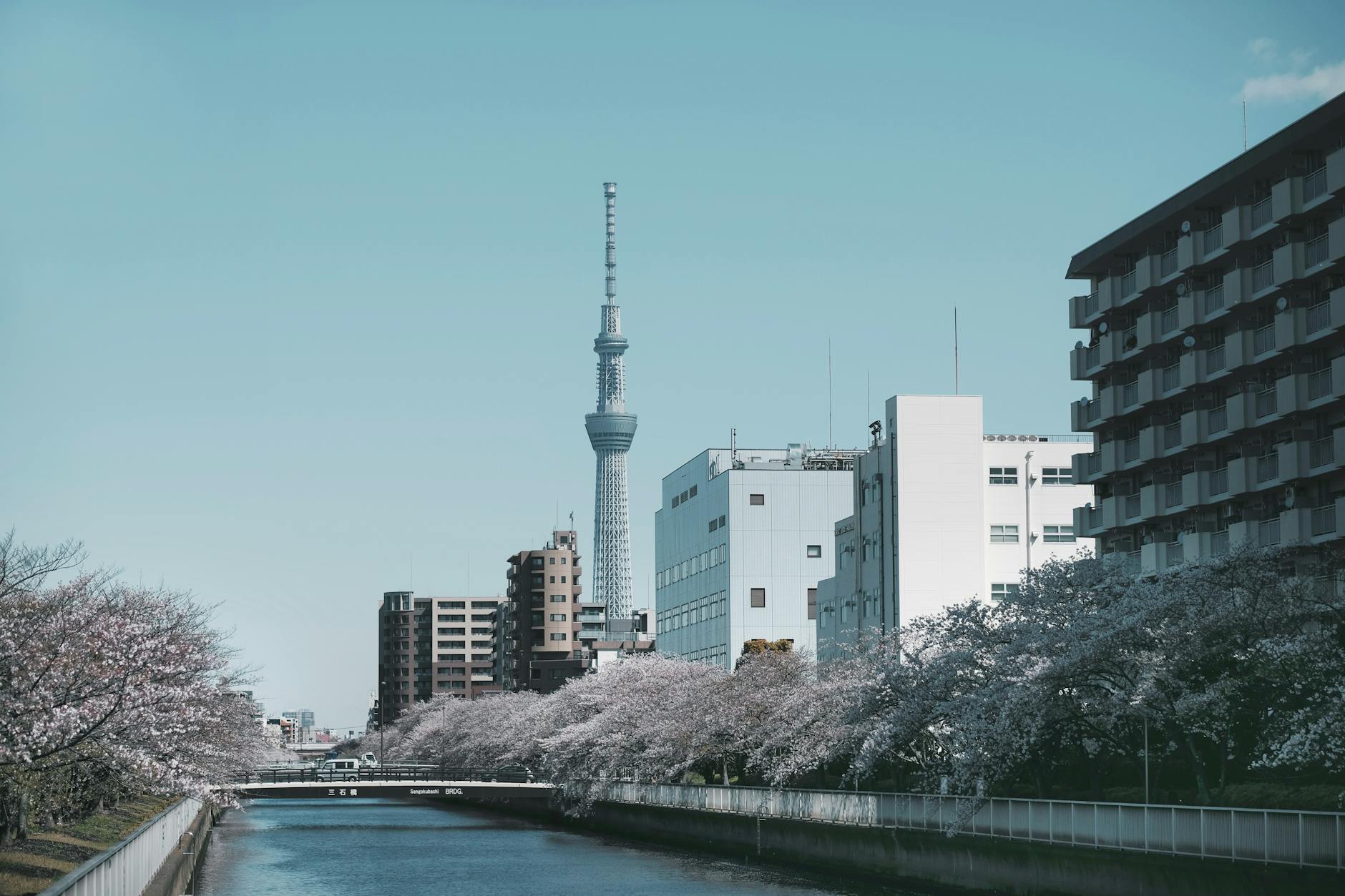
Sumida Park runs along the eastern bank of the river, opposite Asakusa. The cherry
trees here are among the city's most photographed in spring. The Asahi Beer building
and Tokyo Skytree are visible from the riverbank. The river itself has shaped
Asakusa's history — Senso-ji was founded after a statue was pulled from it.
Hanayashiki
Japan's oldest operating amusement park, opened in 1853. It is small by modern
standards but has a documented continuity that few amusement parks in the world can
claim. Worth visiting more for its historical curiosity than for thrills.
A half-day in Asakusa, the way I'd plan it
If a friend asked me to map their Asakusa morning, this is the route I'd give them —
and I'd tell them to start early. Before about 9am the crowds on Nakamise-dōri are
thin enough to actually see the street, and the light on Sensō-ji is better for it.
Kaminarimon (Thunder Gate). Start under the enormous red lantern. It's the postcard shot, so get it before the tour groups arrive.
Nakamise-dōri. The approach to the temple is one of Japan's oldest shopping streets. I'd graze rather than sit down — freshly grilled senbei rice crackers, ningyō-yaki little cakes, and warm age-manjū.
Sensō-ji main hall. Pause at the jōkōrō, the big bronze incense cauldron, before the steps. Then the Five-Storied Pagoda to the left.
Asakusa Shrine. Just beside the temple — the Shintō shrine (locals call it Sanja-sama) sits a few steps from the Buddhist hall, a small lesson in how the two traditions share ground here.
Denbōin-dōri. Duck onto this quieter side street for the old-Tokyo storefronts without the Nakamise crush.
Kappabashi kitchen street. About a ten-minute walk west — the wholesale district for knives, ceramics, and the plastic food samples you've seen in restaurant windows. The best non-obvious souvenir in the area.
Azuma-bashi & the Sumida River. End at the bridge for the clean view across the water to Tokyo Skytree and the Asahi building. It's also where the river cruises to Odaiba and Hamarikyū depart, if you want to keep moving by water.
That loop is a comfortable two to three hours. If you'd rather have the timed tickets
and small-group versions handled before you go, the
tours-platform comparison
covers who books Asakusa experiences best, and a
Japan eSIM keeps the
map live while you wander.
Asakusa has a wide range of options, from traditional ryokans to modern business
hotels. Staying in Asakusa itself gives morning access to Senso-ji before the
crowds arrive — a meaningfully different experience than visiting at noon. Nearby
Ueno (one stop on the Ginza Line) is a practical alternative with strong train
connections to other Tokyo neighborhoods.
Our Tokyo stay guide names three places here, from The Gate Hotel Kaminarimon and its rooftop view to a hostel with a café-bar in Kuramae, with the catch for each. To compare the booking sites themselves, see our comparison of hotel booking sites.
How to visit
Transit: Asakusa Station serves the Tokyo Metro Ginza Line and the Toei Asakusa Line. Both lines connect to most major Tokyo destinations within 30 minutes.
From Narita Airport: Keisei Skyliner to Ueno (~45 min), then one Ginza Line stop.
From Haneda Airport: Toei Asakusa Line direct (~35 min).
Best timing: 06:00–08:00 or 18:00–21:00 for low crowds. The temple grounds are open 24 hours.
Etiquette: Photography is permitted in most of the temple grounds. Speaking loudly inside the main hall is discouraged. Coin offerings at the main hall are typical but not required.
What this neighborhood asks of visitors
The most useful frame for visiting Asakusa is to remember that almost nothing here
is original. The wood you photograph was milled in your parents' lifetime. The gate
you walk under is younger than most of your grandparents. The pagoda you admire is
roughly the age of your laptop's operating system.
And yet, the temple has been here, in some form, since 645 CE. That endurance is
not architectural. It is cultural. Asakusa was destroyed in 1923 and rebuilt; almost
entirely destroyed in 1945 and rebuilt again. The act of rebuilding is the
continuity. The wood is just the medium.
Visitors who carry this perspective into Asakusa tend to leave with more than
photographs. They leave with an understanding of what a city is, and what it does
when it must start again.
Gently Yonder note:
If you have time for only one early morning in Tokyo, spend it walking through
Senso-ji before 7:30. The contrast between this neighborhood at dawn and at noon is
among the city's clearest illustrations of how mass tourism reshapes a place.
FAQ: Asakusa
Is Senso-ji temple original or reconstructed?
The current main hall and pagoda are reconstructions. The temple was founded in 645 CE but has been destroyed and rebuilt multiple times — most recently after the 1945 Tokyo firebombing, which destroyed nearly all of Asakusa. The current main hall was completed in 1958, the pagoda in 1973.
What was Asakusa like before World War II?
Asakusa was Tokyo's leading entertainment district — kabuki theatre, early cinema, vaudeville, and popular performance. The Sixth District (Rokku) was the city's first cinema row. The 1923 earthquake damaged the area severely, but it was quickly rebuilt and remained Tokyo's main entertainment quarter through the 1930s.
Where should I stay near Asakusa?
Asakusa itself offers a range from traditional ryokans to modern hotels. Staying in Asakusa gives early-morning temple access before crowds arrive. Alternative bases include nearby Ueno (one Ginza Line stop away) or Akihabara, both with strong train connections.
What is the best time to visit Senso-ji?
Early morning (before 8:00) or after sunset, when the gates and pagoda are illuminated. Mid-day between 10:00 and 16:00 sees the heaviest crowds. The temple grounds are open 24 hours; the main hall opens at 6:00 and closes at 17:00.
Is there public transport from the airport to Asakusa?
From Narita: Keisei Skyliner to Ueno (~45 min), then one Ginza Line stop. From Haneda: Toei Asakusa Line direct (~35 min). Both routes are simpler than taking the JR system from the airports.
Bottom line
Asakusa is not an ancient neighborhood preserved in amber. It is a neighborhood that
was destroyed twice within a single human lifetime and chose, both times, to rebuild
the same gestures. Walk through it knowing what was lost and what continues, and
the photographs will mean more than they would have otherwise.
Free. The welcome checklist arrives instantly. Unsubscribe in one click, anytime.
Sources & further reading
Senso-ji Temple official documentation and visitor materials.
Asakusa Cultural Tourist Information Center publications.
Seidensticker, E. Low City, High City: Tokyo from Edo to the Earthquake, 1867–1923. Knopf, 1983.
Seidensticker, E. Tokyo Rising: The City Since the Great Earthquake. Knopf, 1990.
Schmorleitz, M. S. "The Bombing of Tokyo, March 9–10, 1945." Aerospace Historian, 1969.
Selden, M. "A Forgotten Holocaust: U.S. Bombing Strategy, the Destruction of Japanese Cities, and the American Way of War from the Pacific War to Iraq." The Asia-Pacific Journal, 2007.
Tokyo Metropolitan Government archives, Asakusa district records.
Tours and tickets in Asakusa
Asakusa is dense with bookable experiences. A few worth lining up before you visit:
Klook — tours, tickets, and transfers across Asia
Strong coverage in Japan, Korea, Vietnam, Thailand, Hong Kong, Taiwan, and Singapore. Skip-the-line tickets, day tours, airport transfers, and pocket Wi-Fi. Often the cheapest reliable option for major attractions in Asian capitals.
Stronger than Klook for off-beat Japan-specific bookings: tea ceremonies, kimono rental, ninja workshops, small-group food tours. Smaller catalog overall, but often the only place these are bookable in English.